
Methyl Halides
Methylated halogens (CH3Cl, CH3Br, CH3I) are novel biosignatures that are produced in both marine and terrestrial environments by microorganisms and higher forms of life (fungi, plants, etc.) and have higher biological specificity (less abiotic production mechanisms) compared to the commonly studied biosignatures such as H2O, CH4, O2 & O3.
Instrument Setup
We use a Fourier Transform Infrared (IR) Spectrometer (FTIR).

Data Collection
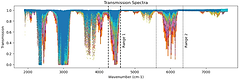
We collect spectra at varying pressures at room temperature. We can calculate the transmission spectroscopy by dividing a sample cell spectra by the empty cell spectra, with the goal of removing any impurities that may be in the cell.
Linearity Tests
We can test which sets of spectra are valid to use by determining the linear relationship between absorbance (y-axis; -ln(transmission)) and burden (x-axis; pressure * cell path length) with the Pearson Correlation Coefficient.

Cross Sections
Once the valid spectra are determined, we can calculate the average cross section.


Integrating Absorption Cross Sections into Retreivals
With these newly obtained absorption cross sections of methyl halides in the Near-Infrared (NIR), we can incorporate them into retrieval models to understand how detectability varies with various planetary scenarios and technological capabilities - stay tuned as I explore this more!